• UGM
  • Academic Portal
  • IT Center
  • Library
  • Research
  • Webmail
  • Informasi Publik
Universitas Gadjah Mada Fakultas Kehutanan
Universitas Gadjah Mada
  • Tentang Kami
    • Sambutan Dekan
    • Selayang Pandang
    • VISI MISI
    • Sejarah Fakultas
    • Pimpinan Fakultas
    • Pimpinan Departemen
    • Pimpinan Program Studi
    • Pimpinan Laboratorium
    • DOSEN
    • STAFF TENDIK
    • Laporan TAHUNAN Dekan
    • ALUMNI
  • Akademik
    • PROGRAM SARJANA
    • PROGRAM MAGISTER
    • PROGRAM DOKTOR
    • PROGRAM PROFESI
    • AKREDITASI PROGRAM STUDI
    • Double Degree
    • KALENDER AKADEMIK
  • KEMAHASISWAAN
    • KEMAHASISWAAN
    • LEM-DPM
      • Lembaga Eksekutif Mahasiswa
      • Dewan Perwakilan Mahasiswa
    • BSO
      • Mapala Silvagama
      • KSK
      • IFSA LC UGM
      • FSC
      • KMIK
      • KMKK BONITA
    • HMM
      • FORESTECH
      • HIMABA
      • FORESTATION
      • KMMH
    • PIONIR UGM
  • RISET & INOVASI
    • Publikasi Riset Dosen & Mahasiswa
    • HKI/PATEN/HAK CIPTA
    • Jurnal Ilmu Kehutanan
    • KERJASAMA
    • PUSAT KAJIAN
      • “SEBIJAK” INSTITUTE
      • SJB
    • KHDTK WANAGAMA
  • PENERIMAAN MAHASISWA
    • SARJANA KEHUTANAN
    • PROFESI INSINYUR KEHUTANAN
    • MAGISTER ILMU KEHUTANAN
    • DOKTOR ILMU KEHUTANAN
  • Beranda
  • berita penelitian dan publikasi
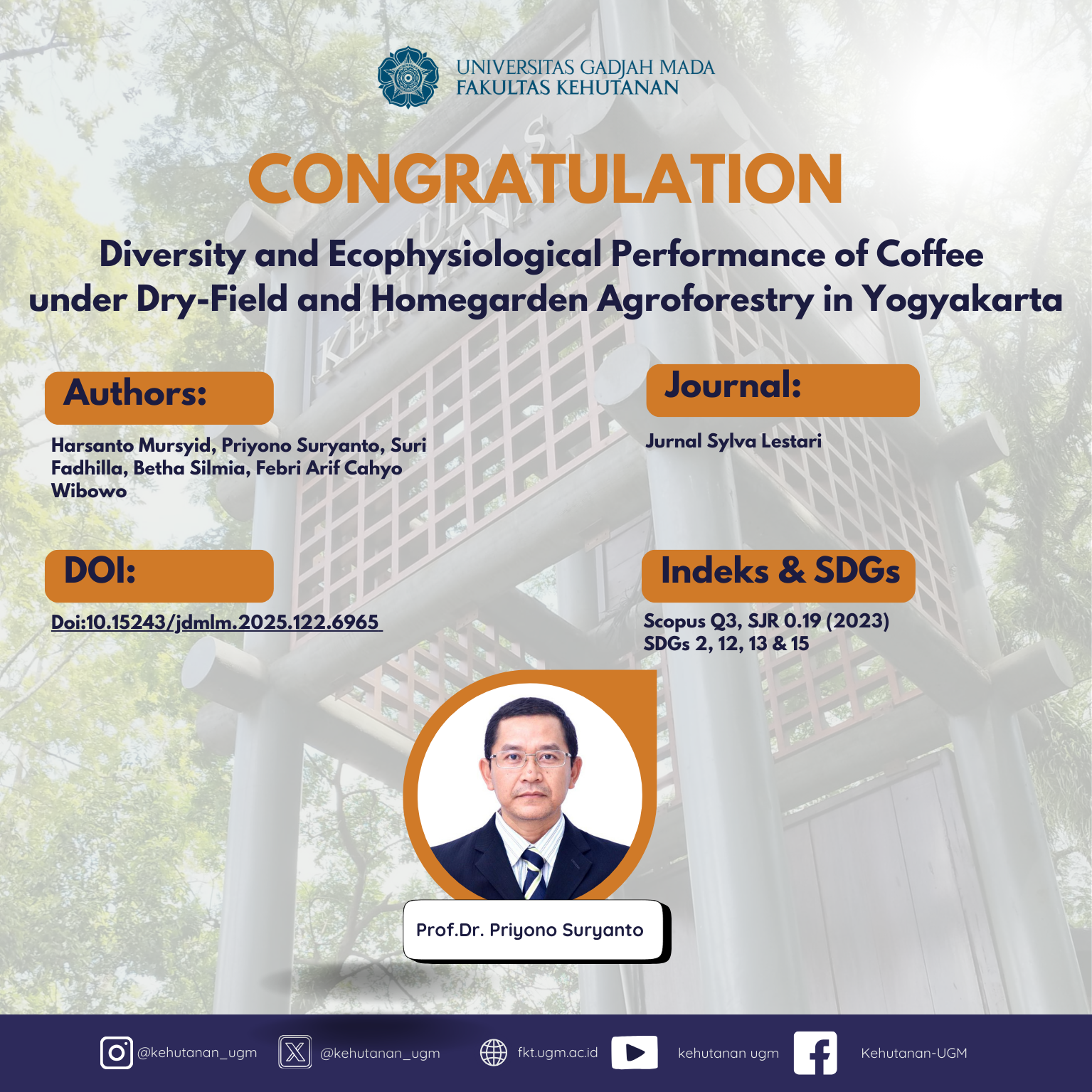
  • Diversity and Ecophysiological Performance of Coffee under Dry-Field and Homegarden Agroforestry in Yogyakarta

Diversity and Ecophysiological Performance of Coffee under Dry-Field and Homegarden Agroforestry in Yogyakarta

  • berita penelitian dan publikasi
  • 27 February 2025, 03.01
  • Oleh: Bag. Riset & Literasi
  • 0

Abstract
Coffee is commonly cultivated under agroforestry systems, including dry-field and homegarden. These systems were differentiated based on their proximity to the settlements, which might influence the species composition. This study aimed to observe plant composition, diversity, vegetation structure, and microclimate in coffee agroforestry systems and the physiological conditions of coffee. The experimental design was based on purposive sampling. A total of 100 nested plots were established in Glagaharjo and Balerante of Yogyakarta, each consisting of a dry-field and homegarden. Higher diversity and potential products were observed in dry-field agroforestry. There was no significant difference in microclimate between both systems. However, a significantly higher number of poles (p < 0.001) and trees (p 0.05). Therefore, microclimate conditions under dry-fields were considered suitable for improving coffee growth performance.

SDGs:
SDG 2: No Hunger
SDG 12: Responsible Consumtion and Production
SDG 13: Climate Action
SDG 15: Life on Land

Link Dokumen:
Download

Tags: sdg SDGs 13 Climate Action SDGs 15 Life On Land SDGs2 Tanpa Kelaparan
Universitas Gadjah Mada

FAKULTAS KEHUTANAN
Universitas Gadjah Mada
Jl. Agro No. 1 Bulaksumur Yogyakarta 55281
Telp. (0274) 512102, 6491420 Fax. (0274) 550541
Email: fkt@ugm.ac.id

UNIVERSITY ADMISSION

  • SNMPTN
  • SBMPTN
  • PBUTM
  • UTUL

DEPARTMENT

  • Forest Management
  • Forest Product Technology
  • Silviculture
  • Forest Resource Conservation

Informasi Publik

  • Permohonan Informasi Publik
  • Daftar Informasi Tersedia Secara Berkala
  • Daftar Informasi Tersedia Setiap Saat

© FKT - Universitas Gadjah Mada

KEBIJAKAN PRIVASI/PRIVACY POLICY

[EN] We use cookies to help our viewer get the best experience on our website. -- [ID] Kami menggunakan cookie untuk membantu pengunjung kami mendapatkan pengalaman terbaik di situs web kami.I Agree / Saya Setuju