• UGM
  • Academic Portal
  • IT Center
  • Library
  • Research
  • Webmail
  • Informasi Publik
  • Languages
Universitas Gadjah Mada Fakultas Kehutanan
Universitas Gadjah Mada
  • Tentang Kami
    • Visi dan MIsi
    • Kelembagaan Fakultas
    • Sejarah dan Perkembangan
    • Staff Pendidik
  • Akademik
    • Sistem Pendidikan
    • Departemen
    • Sistem Kredit Semester
    • BUKU PANDUAN AKADEMIK
  • KEMAHASISWAAN
    • KEMAHASISWAAN
    • LEM
    • PPSMB Pelestari
  • Penelitian dan Publikasi
    • Berita Penelitian dan Publikasi
    • Penelitian
    • Publikasi
    • Kekayaan Intelektual
    • Jangka Benah
  • Pengabdian Masyarakat
    • Pengabdian Dosen
    • Kerja Sama
    • WANAGAMA
    • KHDTK NGANDONG-GETAS
  • Beranda
  • berita penelitian dan publikasi
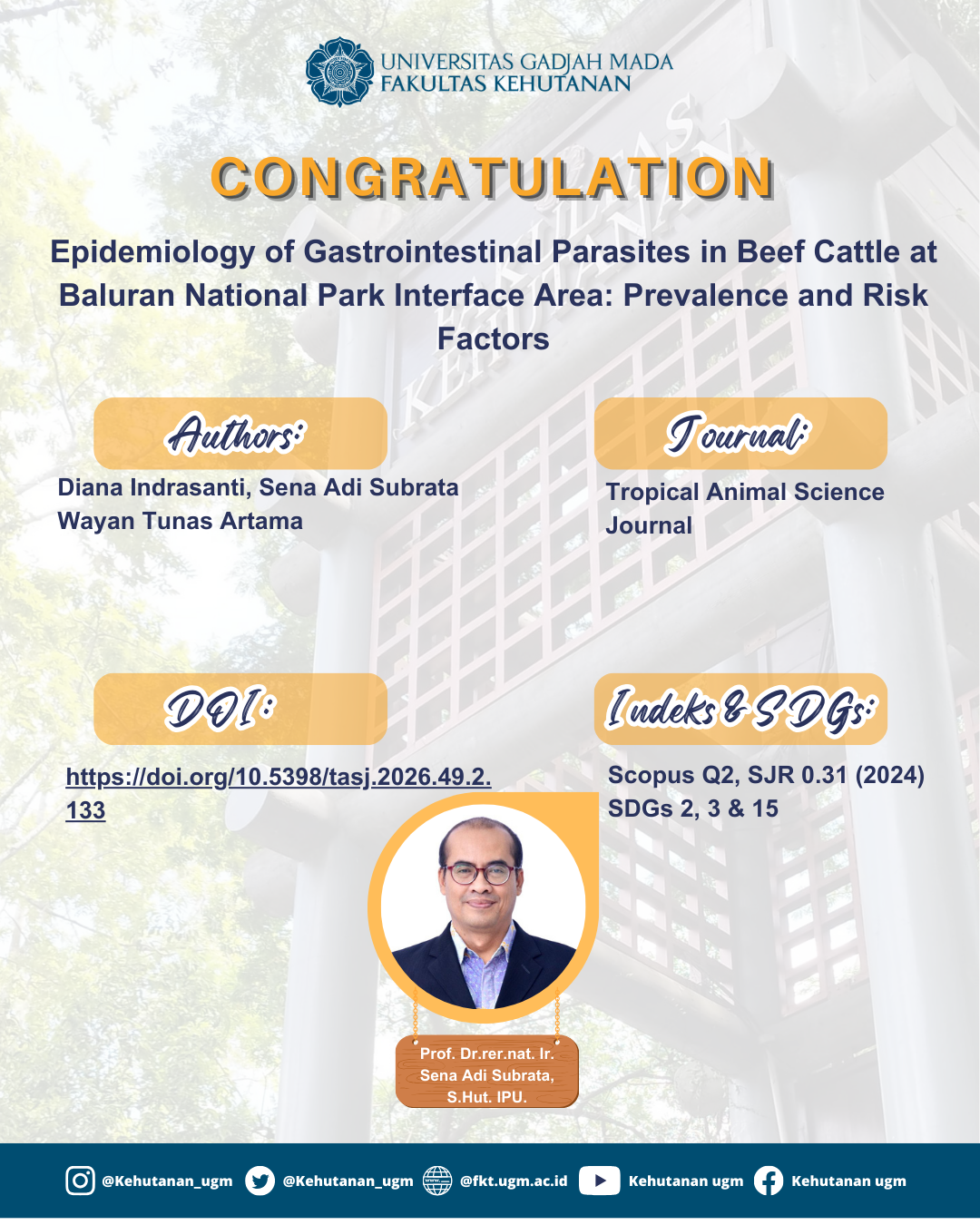
  • Epidemiology of Gastrointestinal Parasites in Beef Cattle at Baluran National Park Interface Area: Prevalence and Risk Factors

Epidemiology of Gastrointestinal Parasites in Beef Cattle at Baluran National Park Interface Area: Prevalence and Risk Factors

  • berita penelitian dan publikasi
  • 9 February 2026, 02.44
  • Oleh: Bag. Riset & Literasi
  • 0

Abstract
Beef cattle are commonly infected by gastrointestinal parasites, which impact productivity and cause economic losses. Therefore, this research aimed to analyze the prevalence and risk factors of gastrointestinal parasites in beef cattle at Baluran National Park (BNP). A cross-sectional design was used from June to December 2024, with random sampling in five areas of the BNP interface, namely Air Karang, Lempuyang, Merak, Sirondo, and Simacan. In this context, 166 feces samples were collected from 25 farms and analyzed using flotation and sedimentation methods. A survey was applied to collect information about farmers, management, environment, sanitation, and biosecurity. The results showed that 51.2% (85/166) of the sample were positive for eggs or oocysts of one or more species of gastrointestinal parasites. Furthermore, this research identified nine genera, namely Bunostomum spp. (7.2%), Cooperia spp. (15.6%), Haemonchus spp. (4.8%), Oesophagostomum spp. (9%), Ostertagia spp. (3.6%), Strongylus spp. (2.4%), Trichostrongylus spp. (12.6%), Fasciola spp.(4.8%), and Eimeria spp. (4.2%). The samples were infected with a single infection (78,82%), while the multiple infection rate was 21,18%. Chi-square and odds ratio test suggested that pen area (p = 0.001), grazing area (p = 0.010), BCS (0.034), contact with wild ruminants (p = 0.030; OR = 2.033), infrequent pen cleaning (p = 0.004; OR = 2.581), the presence of blood in feces (p = 0.005; OR = 4.084), and pen near from house (p = 0.049; OR = 0.488) were associated with infection risk. Gastrointestinal parasites in beef cattle at the Baluran National Park interface exhibit high diversity of parasite species and are closely associated with geographic location, forest-based grazing practices, and poor body condition of the cattle.

SDGs:
SDG 2:Zero Hunger
SDG 3:Good Health and Well-Being
SDG 15:Life on Land

Link Dokumen:
Download

Leave A Comment Cancel reply

Your email address will not be published. Required fields are marked *

*

Universitas Gadjah Mada

FAKULTAS KEHUTANAN
Universitas Gadjah Mada
Jl. Agro No. 1 Bulaksumur Yogyakarta 55281
Telp. (0274) 512102, 6491420 Fax. (0274) 550541
Email: fkt@ugm.ac.id

UNIVERSITY ADMISSION

  • SNMPTN
  • SBMPTN
  • PBUTM
  • UTUL

DEPARTMENT

  • Forest Management
  • Forest Product Technology
  • Silviculture
  • Forest Resource Conservation

Informasi Publik

  • Permohonan Informasi Publik
  • Daftar Informasi Tersedia Secara Berkala
  • Daftar Informasi Tersedia Setiap Saat

© FKT - Universitas Gadjah Mada

KEBIJAKAN PRIVASI/PRIVACY POLICY

[EN] We use cookies to help our viewer get the best experience on our website. -- [ID] Kami menggunakan cookie untuk membantu pengunjung kami mendapatkan pengalaman terbaik di situs web kami.I Agree / Saya Setuju