• UGM
  • Academic Portal
  • IT Center
  • Library
  • Research
  • Webmail
  • Informasi Publik
Universitas Gadjah Mada Fakultas Kehutanan
Universitas Gadjah Mada
  • Tentang Kami
    • Sambutan Dekan
    • Selayang Pandang
    • VISI MISI
    • Sejarah Fakultas
    • Pimpinan Fakultas
    • Pimpinan Departemen
    • Pimpinan Program Studi
    • Pimpinan Laboratorium
    • DOSEN
    • STAFF TENDIK
    • Laporan TAHUNAN Dekan
    • ALUMNI
  • Akademik
    • PROGRAM SARJANA
    • PROGRAM MAGISTER
    • PROGRAM DOKTOR
    • PROGRAM PROFESI
    • AKREDITASI PROGRAM STUDI
    • Double Degree
    • KALENDER AKADEMIK
  • KEMAHASISWAAN
    • KEMAHASISWAAN
    • LEM-DPM
      • Lembaga Eksekutif Mahasiswa
      • Dewan Perwakilan Mahasiswa
    • BSO
      • Mapala Silvagama
      • KSK
      • IFSA LC UGM
      • FSC
      • KMIK
      • KMKK BONITA
    • HMM
      • FORESTECH
      • HIMABA
      • FORESTATION
      • KMMH
    • PIONIR UGM
  • RISET & INOVASI
    • Publikasi Riset Dosen & Mahasiswa
    • HKI/PATEN/HAK CIPTA
    • Jurnal Ilmu Kehutanan
    • KERJASAMA
    • PUSAT KAJIAN
      • “SEBIJAK” INSTITUTE
      • SJB
      • PUSAT KAJIAN KEHUTANAN SOSIAL
    • KHDTK WANAGAMA
  • ADMISI
    • SARJANA KEHUTANAN
    • PROFESI INSINYUR KEHUTANAN
    • MAGISTER ILMU KEHUTANAN
    • DOKTOR ILMU KEHUTANAN
  • PENJAMINAN MUTU
  • Beranda
  • berita penelitian dan publikasi
  • Variation of Fertility and Its Impact on Seed Harvesting in Seed Production Area of Sandalwood in Indonesia

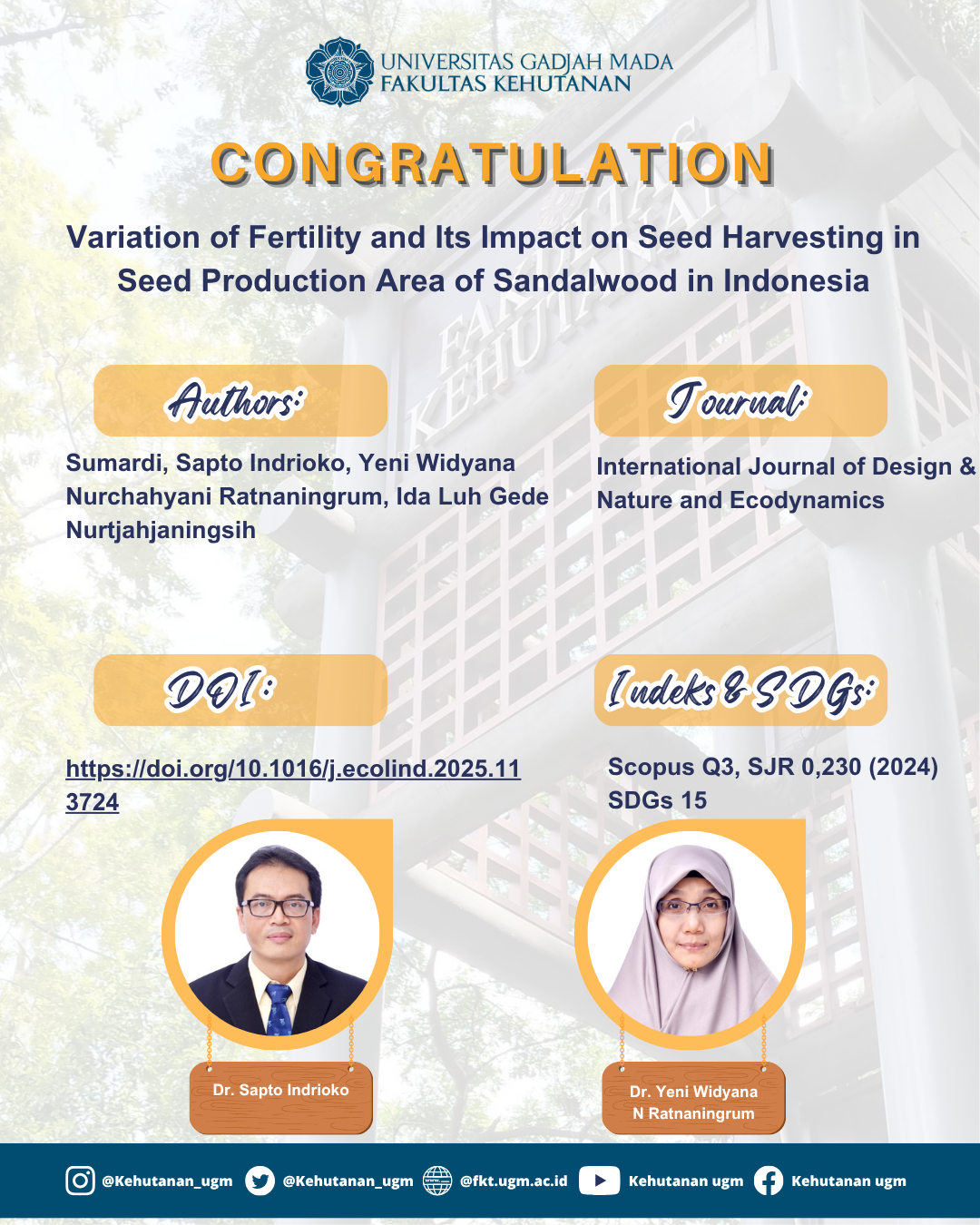
Variation of Fertility and Its Impact on Seed Harvesting in Seed Production Area of Sandalwood in Indonesia

  • berita penelitian dan publikasi
  • 25 May 2025, 02.53
  • Oleh: Bag. Riset & Literasi
  • 0

Abstract
The Seed Production Area (SPA) of sandalwood (Santalum album L.) in East Nusa Tenggara is Indonesia’s sole designated site for sandalwood seed production. It was established 32 years ago using trees from six provenances on Timor Island. The SPA supports regional economies and ecological protection by producing high-quality seeds for commercially valuable trees and species conservation. Despite annual seed collection, information on reproductive status, genetic diversity, and genetic drift is limited. This study assessed fertility variation, genetic diversity, and the impacts of genetic drift on sandalwood seed production. Fertility was assessed through flower and fruit production, while genetic diversity was calculated using fertility and genetic drift data. The results showed high fertility variation (2.98), high genetic diversity (0.97), and low co-ancestry (0.03). This study revealed that 14.04% of trees contributed over 50% of the reproductive output. The effective population size (19.15%) indicates that a small percentage of trees contribute highly to seed production. To avoid dominance by highly fertile trees, seed collection is limited and mixed equally. These results provide a scientific basis for strategic seed production and genetic resource management. Recommendations include selectively pruning the crowns of highly fertile trees, increasing the number of fertile trees, and stimulating less fertile individuals to increase seed production while maintaining genetic diversity in the SPA.

SDGs:
SDG 15:Life on Land

Link Dokumen:
Download

Tags: SDGs 15 Life On Land
Universitas Gadjah Mada

FAKULTAS KEHUTANAN
Universitas Gadjah Mada
Jl. Agro No. 1 Bulaksumur Yogyakarta 55281
Telp. (0274) 512102, 6491420 Fax. (0274) 550541
Email: fkt@ugm.ac.id

UNIVERSITY ADMISSION

  • SNMPTN
  • SBMPTN
  • PBUTM
  • UTUL

DEPARTMENT

  • Forest Management
  • Forest Product Technology
  • Silviculture
  • Forest Resource Conservation

Informasi Publik

  • Permohonan Informasi Publik
  • Daftar Informasi Tersedia Secara Berkala
  • Daftar Informasi Tersedia Setiap Saat

© FKT - Universitas Gadjah Mada

KEBIJAKAN PRIVASI/PRIVACY POLICY

[EN] We use cookies to help our viewer get the best experience on our website. -- [ID] Kami menggunakan cookie untuk membantu pengunjung kami mendapatkan pengalaman terbaik di situs web kami.I Agree / Saya Setuju