• UGM
  • Academic Portal
  • IT Center
  • Library
  • Research
  • Webmail
  • Informasi Publik
Universitas Gadjah Mada Fakultas Kehutanan
Universitas Gadjah Mada
  • Tentang Kami
    • Sambutan Dekan
    • Selayang Pandang
    • VISI MISI
    • Sejarah Fakultas
    • Pimpinan Fakultas
    • Pimpinan Departemen
    • Pimpinan Program Studi
    • Pimpinan Laboratorium
    • DOSEN
    • STAFF TENDIK
    • Laporan TAHUNAN Dekan
    • ALUMNI
  • Akademik
    • PROGRAM SARJANA
    • PROGRAM MAGISTER
    • PROGRAM DOKTOR
    • PROGRAM PROFESI
    • AKREDITASI PROGRAM STUDI
    • Double Degree
    • KALENDER AKADEMIK
  • KEMAHASISWAAN
    • KEMAHASISWAAN
    • LEM-DPM
      • Lembaga Eksekutif Mahasiswa
      • Dewan Perwakilan Mahasiswa
    • BSO
      • Mapala Silvagama
      • KSK
      • IFSA LC UGM
      • FSC
      • KMIK
      • KMKK BONITA
    • HMM
      • FORESTECH
      • HIMABA
      • FORESTATION
      • KMMH
    • PIONIR UGM
  • RISET & INOVASI
    • Publikasi Riset Dosen & Mahasiswa
    • HKI/PATEN/HAK CIPTA
    • Jurnal Ilmu Kehutanan
    • KERJASAMA
    • PUSAT KAJIAN
      • “SEBIJAK” INSTITUTE
      • SJB
      • PUSAT KAJIAN KEHUTANAN SOSIAL
    • KHDTK WANAGAMA
  • ADMISI
    • SARJANA KEHUTANAN
    • PROFESI INSINYUR KEHUTANAN
    • MAGISTER ILMU KEHUTANAN
    • DOKTOR ILMU KEHUTANAN
  • PENJAMINAN MUTU
  • Beranda
  • berita penelitian dan publikasi
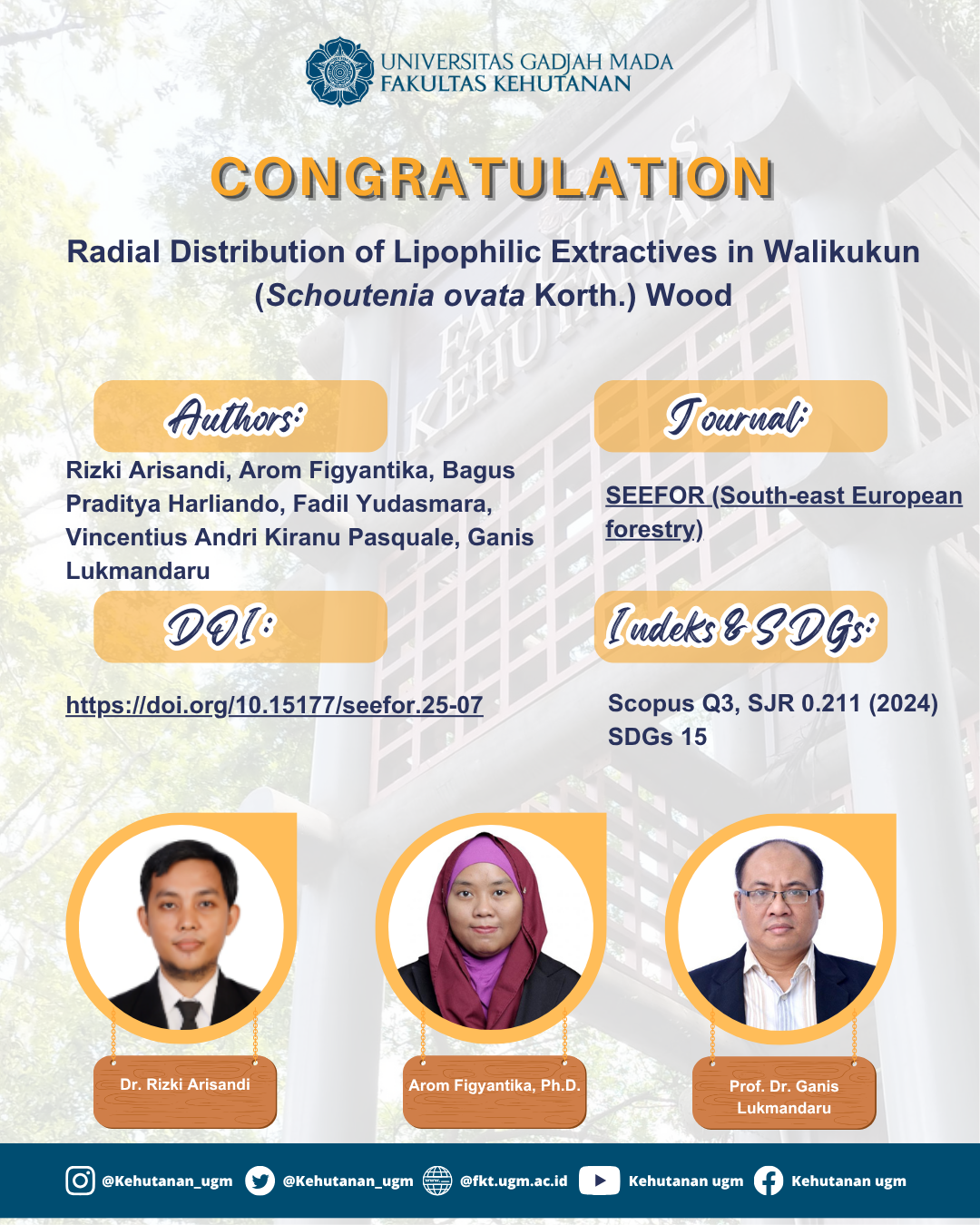
  • Radial Distribution of Lipophilic Extractives in Walikukun (Schoutenia ovata Korth.) Wood

Radial Distribution of Lipophilic Extractives in Walikukun (Schoutenia ovata Korth.) Wood

  • berita penelitian dan publikasi
  • 12 June 2025, 04.08
  • Oleh: Bag. Riset & Literasi
  • 0

Abstract
Walikukun (Schoutenia ovata Korth.) is a commercially significant wood species in Indonesia. Heartwood, in particular, is important due to the natural durability and aesthetics, while lipophilic extractives play a crucial role in the formation. Therefore, this study aimed to determine the levels of lipophilic compounds in different radial positions associated with the formation of Walikukun heartwood. The results showed that the mean of n-hexane, methanol, and hot water extractive content ranged from 0.97% to 1.35%, 7.18% to 14.4%, and 1.73% to 2.23% in oven-dried wood, respectively. In general, the total extractive content increased from sapwood to heartwood. This pattern was similar to the methanol extractive content. The highest extractive contents of n-hexane level were in transition zone, followed by heartwood and sapwood. Furthermore, the highest lipophilic compounds were found in alkenes, followed by fatty alcohols, fatty acids, and sterols. Fatty acids and sterols decreased radially from heartwood to sapwood, while fatty alcohols increased from heartwood to transition zone, then decreased to sapwood. The decrease in the proportion of fatty acids, sterols and fatty alcohols from heartwood to sapwood is probably due to the heartwood formation process where lipid compounds are metabolised in the sapwood or transition zone.

SDGs:
SDG 15:Life on Land

Link Dokumen:
Download

Tags: SDGs 15 Life On Land
Universitas Gadjah Mada

FAKULTAS KEHUTANAN
Universitas Gadjah Mada
Jl. Agro No. 1 Bulaksumur Yogyakarta 55281
Telp. (0274) 512102, 6491420 Fax. (0274) 550541
Email: fkt@ugm.ac.id

UNIVERSITY ADMISSION

  • SNMPTN
  • SBMPTN
  • PBUTM
  • UTUL

DEPARTMENT

  • Forest Management
  • Forest Product Technology
  • Silviculture
  • Forest Resource Conservation

Informasi Publik

  • Permohonan Informasi Publik
  • Daftar Informasi Tersedia Secara Berkala
  • Daftar Informasi Tersedia Setiap Saat

© FKT - Universitas Gadjah Mada

KEBIJAKAN PRIVASI/PRIVACY POLICY

[EN] We use cookies to help our viewer get the best experience on our website. -- [ID] Kami menggunakan cookie untuk membantu pengunjung kami mendapatkan pengalaman terbaik di situs web kami.I Agree / Saya Setuju