• UGM
  • Academic Portal
  • IT Center
  • Library
  • Research
  • Webmail
  • Informasi Publik
  • Languages
Universitas Gadjah Mada Fakultas Kehutanan
Universitas Gadjah Mada
  • Tentang Kami
    • Visi dan MIsi
    • Kelembagaan Fakultas
    • Sejarah dan Perkembangan
    • Staff Pendidik
  • Akademik
    • Sistem Pendidikan
    • Departemen
    • Sistem Kredit Semester
    • BUKU PANDUAN AKADEMIK
  • KEMAHASISWAAN
    • KEMAHASISWAAN
    • LEM
    • PPSMB Pelestari
  • Penelitian dan Publikasi
    • Berita Penelitian dan Publikasi
    • Penelitian
    • Publikasi
    • Kekayaan Intelektual
    • Jangka Benah
  • Pengabdian Masyarakat
    • Pengabdian Dosen
    • Kerja Sama
    • WANAGAMA
    • KHDTK NGANDONG-GETAS
  • Beranda
  • berita penelitian dan publikasi
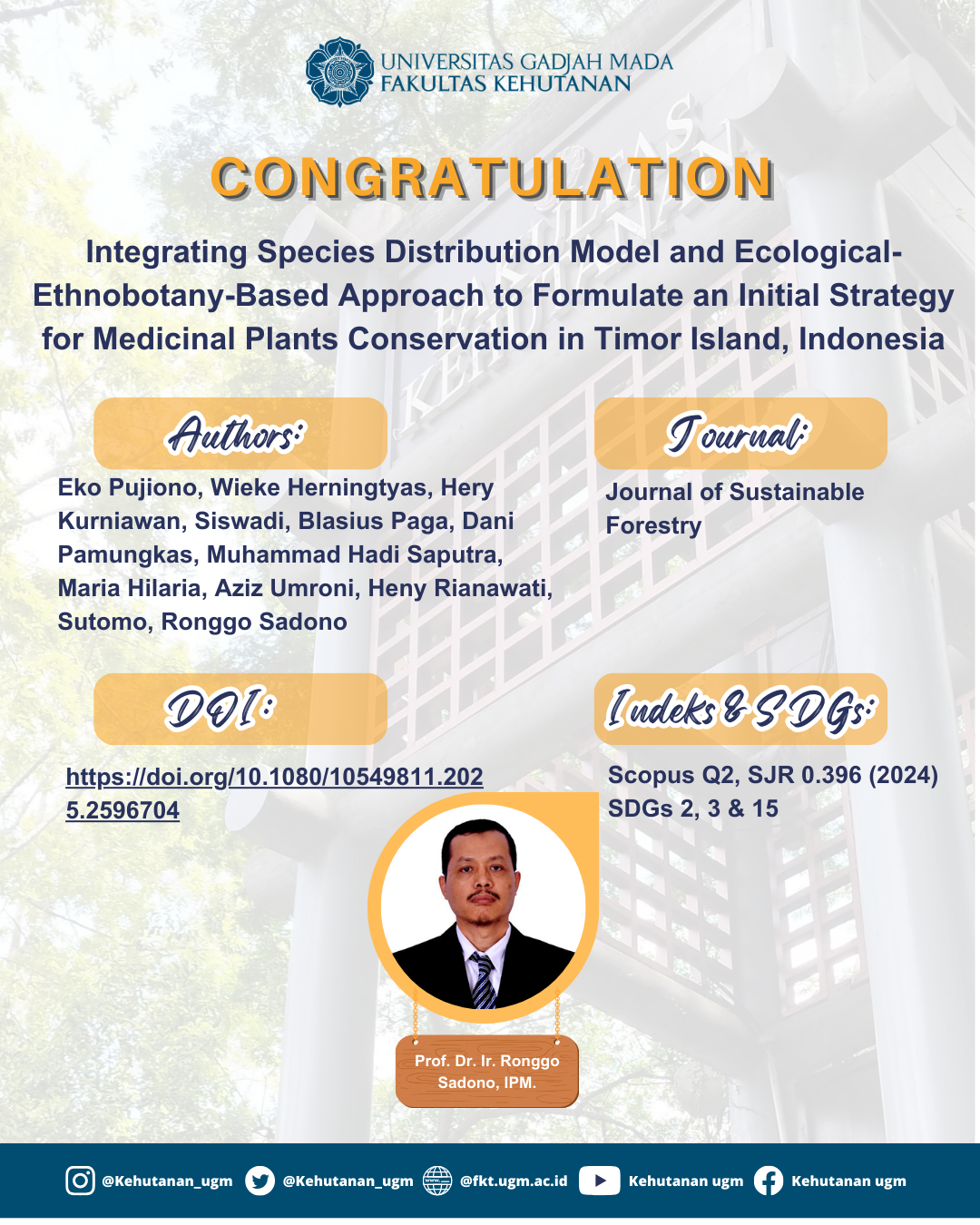
  • Integrating Species Distribution Model and Ecological-Ethnobotany-Based Approach to Formulate an Initial Strategy for Medicinal Plants Conservation in Timor Island, Indonesia

Integrating Species Distribution Model and Ecological-Ethnobotany-Based Approach to Formulate an Initial Strategy for Medicinal Plants Conservation in Timor Island, Indonesia

  • berita penelitian dan publikasi
  • 29 January 2026, 04.52
  • Oleh: Bag. Riset & Literasi
  • 0

Abstract
The Mutis-Timau Forest Complex, Timor Island, in eastern Indonesia has limited forest resources and is threatened by deforestation and degradation. Consequently, forest and natural resource management policies have prioritized on nontimber forest products (NTFPs) development. Although not yet designated as superior NTFPs in Timor, several native medicinal plants – faloak (Sterculia quadrifida), screw tree (Helicteres isora), and beard lichen (Usnea barbata) – demonstrate significant ecological and economic potential. Unfortunately, these species are threatened due to land conversion and excessive use, necessitating conservation action. One of the challenges in conserving these species lies in the scarcity of comprehensive data regarding their ecological distribution, suitable habitat, and traditional use. The research aims to formulate an initial conservation strategy for these medicinal plants. A combination of an ecological approach with Important Value Index, an ethnobotanical approach with Cultural Significance Index and a species distribution modeling with a habitat suitability map were used to determine an initial strategy for conservation action. Results show that these medicinal plants must be cultivated in locations that have a high level of suitability. These initial conservation strategies can be utilized by related parties for sustainable management of medicinal species.

SDGs:
SDG 2:Zero Hunger
SDG 3:Good Health and Well-Being
SDG 15:Life on Land

Link Dokumen:
Download

Leave A Comment Cancel reply

Your email address will not be published. Required fields are marked *

*

Universitas Gadjah Mada

FAKULTAS KEHUTANAN
Universitas Gadjah Mada
Jl. Agro No. 1 Bulaksumur Yogyakarta 55281
Telp. (0274) 512102, 6491420 Fax. (0274) 550541
Email: fkt@ugm.ac.id

UNIVERSITY ADMISSION

  • SNMPTN
  • SBMPTN
  • PBUTM
  • UTUL

DEPARTMENT

  • Forest Management
  • Forest Product Technology
  • Silviculture
  • Forest Resource Conservation

Informasi Publik

  • Permohonan Informasi Publik
  • Daftar Informasi Tersedia Secara Berkala
  • Daftar Informasi Tersedia Setiap Saat

© FKT - Universitas Gadjah Mada

KEBIJAKAN PRIVASI/PRIVACY POLICY

[EN] We use cookies to help our viewer get the best experience on our website. -- [ID] Kami menggunakan cookie untuk membantu pengunjung kami mendapatkan pengalaman terbaik di situs web kami.I Agree / Saya Setuju