• UGM
  • Academic Portal
  • IT Center
  • Library
  • Research
  • Webmail
  • Informasi Publik
Universitas Gadjah Mada Fakultas Kehutanan
Universitas Gadjah Mada
  • Tentang Kami
    • Sambutan Dekan
    • Selayang Pandang
    • VISI MISI
    • Sejarah Fakultas
    • Pimpinan Fakultas
    • Pimpinan Departemen
    • Pimpinan Program Studi
    • Pimpinan Laboratorium
    • DOSEN
    • STAFF TENDIK
    • Laporan TAHUNAN Dekan
    • ALUMNI
  • Akademik
    • PROGRAM SARJANA
    • PROGRAM MAGISTER
    • PROGRAM DOKTOR
    • PROGRAM PROFESI
    • AKREDITASI PROGRAM STUDI
    • Double Degree
    • KALENDER AKADEMIK
  • KEMAHASISWAAN
    • KEMAHASISWAAN
    • LEM-DPM
      • Lembaga Eksekutif Mahasiswa
      • Dewan Perwakilan Mahasiswa
    • BSO
      • Mapala Silvagama
      • KSK
      • IFSA LC UGM
      • FSC
      • KMIK
      • KMKK BONITA
    • HMM
      • FORESTECH
      • HIMABA
      • FORESTATION
      • KMMH
    • PIONIR UGM
  • RISET & INOVASI
    • Publikasi Riset Dosen & Mahasiswa
    • HKI/PATEN/HAK CIPTA
    • Jurnal Ilmu Kehutanan
    • KERJASAMA
    • PUSAT KAJIAN
      • “SEBIJAK” INSTITUTE
      • SJB
      • PUSAT KAJIAN KEHUTANAN SOSIAL
    • KHDTK WANAGAMA
  • ADMISI
    • SARJANA KEHUTANAN
    • PROFESI INSINYUR KEHUTANAN
    • MAGISTER ILMU KEHUTANAN
    • DOKTOR ILMU KEHUTANAN
  • PENJAMINAN MUTU
  • Beranda
  • berita penelitian dan publikasi
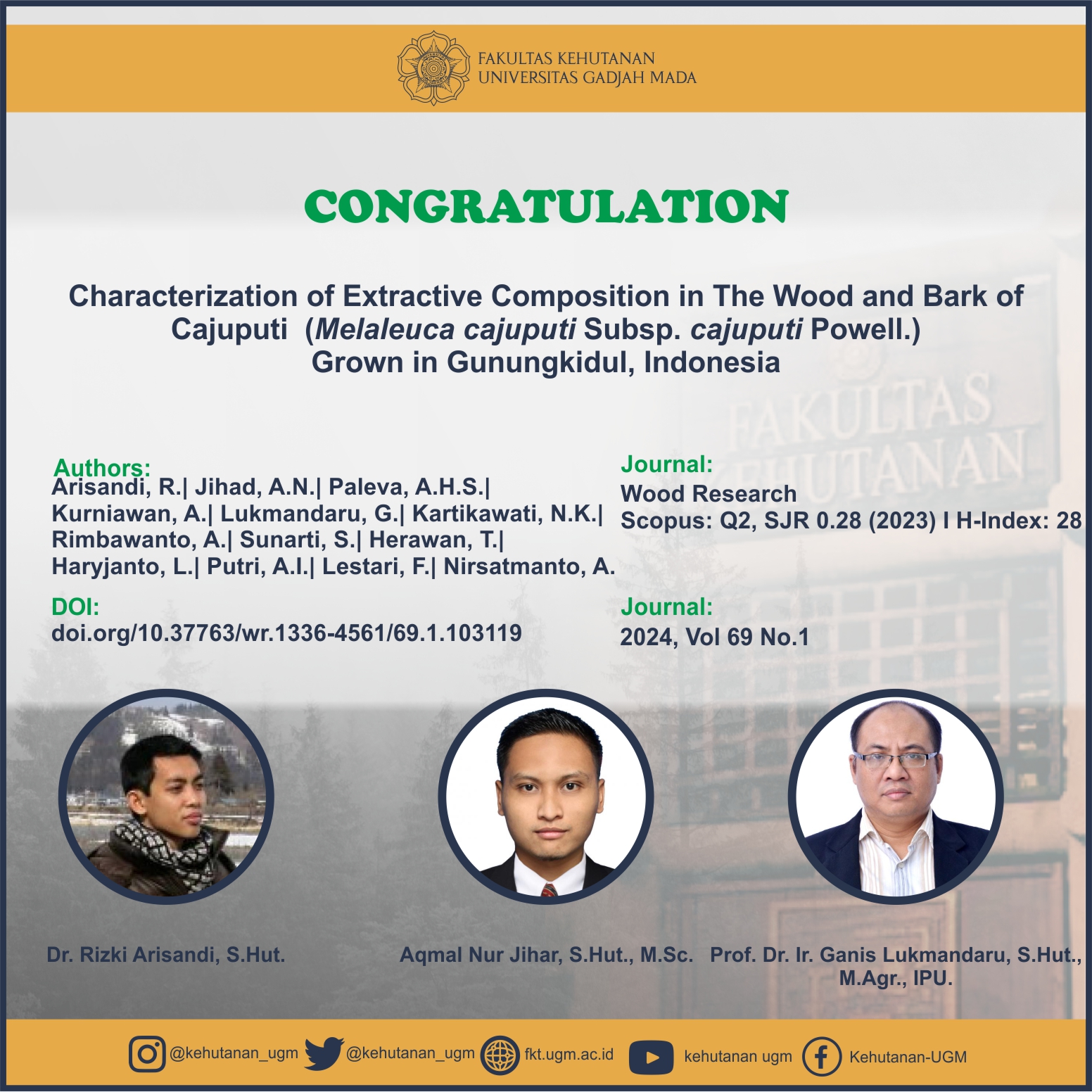
  • Publication: Characterization of Extractive Composition in The Wood and Bark of Cajuputi (Melaleuca Cajuputi Subsp. Cajuputi Powell.) Grown in Gunungkidul, Indonesia

Publication: Characterization of Extractive Composition in The Wood and Bark of Cajuputi (Melaleuca Cajuputi Subsp. Cajuputi Powell.) Grown in Gunungkidul, Indonesia

  • berita penelitian dan publikasi
  • 12 April 2024, 06.40
  • Oleh: Bag. Riset & Literasi
  • 0

Abstract
The aim of this study was to analyze the extractive composition of the wood and bark of cajuput (M. cajuputi subsp. cajuputi) to consider the end use material according to the characteristics of the its extractives. Results showed that the extractives properties of M. cajuputi, i.e. the contents of n-hexane, methanol, hot water extractives and total phenolic content (TPC), flavonoid content (TFC) and total polysaccharides (TSP) were 0.84 to 1.05%, 1.00 to 1.03% and 1.43 to 1.46%, and 19.2 to 38.7 and 23.2 to 27.3 mg GAE/g dried extract, 11.8 to 16.0 and 7.55 to 14.0 mg QE/g dried extract and 79.3 to 102.8 and 148.8 to 165.9 mg
Glu/g dried extract, respectively. Bark had higher extractive levels than wood. In addition, TPC and TSP in the bark were greater than in the wood parts, whereas the reverse trend was found in
TFC. The relatively high contents of TPC and TFC in the wood and bark suggest that their potential antioxidant properties. Based on the GC-MS analysis, the high content of
sterols-steroids (31.4%) and triterpenoids (21.9%) in the bark part will have potential in the field of pharmacology.

SDGs:
1. SDGs 3:Good Health and Well-being
2. SDGs 9:Industry, Innovation, and Infrastructure
3. SDGs 12:Responsible Consumption and Production
4. SDGs 13:Climate Action
5. SDGs 15:Life on Land

Link Dokumen:
Download

Leave A Comment Cancel reply

Your email address will not be published. Required fields are marked *

*

Universitas Gadjah Mada

FAKULTAS KEHUTANAN
Universitas Gadjah Mada
Jl. Agro No. 1 Bulaksumur Yogyakarta 55281
Telp. (0274) 512102, 6491420 Fax. (0274) 550541
Email: fkt@ugm.ac.id

UNIVERSITY ADMISSION

  • SNMPTN
  • SBMPTN
  • PBUTM
  • UTUL

DEPARTMENT

  • Forest Management
  • Forest Product Technology
  • Silviculture
  • Forest Resource Conservation

Informasi Publik

  • Permohonan Informasi Publik
  • Daftar Informasi Tersedia Secara Berkala
  • Daftar Informasi Tersedia Setiap Saat

© FKT - Universitas Gadjah Mada

KEBIJAKAN PRIVASI/PRIVACY POLICY

[EN] We use cookies to help our viewer get the best experience on our website. -- [ID] Kami menggunakan cookie untuk membantu pengunjung kami mendapatkan pengalaman terbaik di situs web kami.I Agree / Saya Setuju