• UGM
  • Academic Portal
  • IT Center
  • Library
  • Research
  • Webmail
  • Informasi Publik
Universitas Gadjah Mada Fakultas Kehutanan
Universitas Gadjah Mada
  • Tentang Kami
    • Sambutan Dekan
    • Selayang Pandang
    • VISI MISI
    • Sejarah Fakultas
    • Pimpinan Fakultas
    • Pimpinan Departemen
    • Pimpinan Program Studi
    • Pimpinan Laboratorium
    • DOSEN
    • STAFF TENDIK
    • Laporan TAHUNAN Dekan
    • ALUMNI
  • Akademik
    • PROGRAM SARJANA
    • PROGRAM MAGISTER
    • PROGRAM DOKTOR
    • PROGRAM PROFESI
    • AKREDITASI PROGRAM STUDI
    • Double Degree
    • KALENDER AKADEMIK
  • KEMAHASISWAAN
    • KEMAHASISWAAN
    • LEM-DPM
      • Lembaga Eksekutif Mahasiswa
      • Dewan Perwakilan Mahasiswa
    • BSO
      • Mapala Silvagama
      • KSK
      • IFSA LC UGM
      • FSC
      • KMIK
      • KMKK BONITA
    • HMM
      • FORESTECH
      • HIMABA
      • FORESTATION
      • KMMH
    • PIONIR UGM
  • RISET & INOVASI
    • Publikasi Riset Dosen & Mahasiswa
    • HKI/PATEN/HAK CIPTA
    • Jurnal Ilmu Kehutanan
    • KERJASAMA
    • PUSAT KAJIAN
      • “SEBIJAK” INSTITUTE
      • SJB
      • PUSAT KAJIAN KEHUTANAN SOSIAL
    • KHDTK WANAGAMA
  • ADMISI
    • SARJANA KEHUTANAN
    • PROFESI INSINYUR KEHUTANAN
    • MAGISTER ILMU KEHUTANAN
    • DOKTOR ILMU KEHUTANAN
  • PENJAMINAN MUTU
  • Beranda
  • berita penelitian dan publikasi
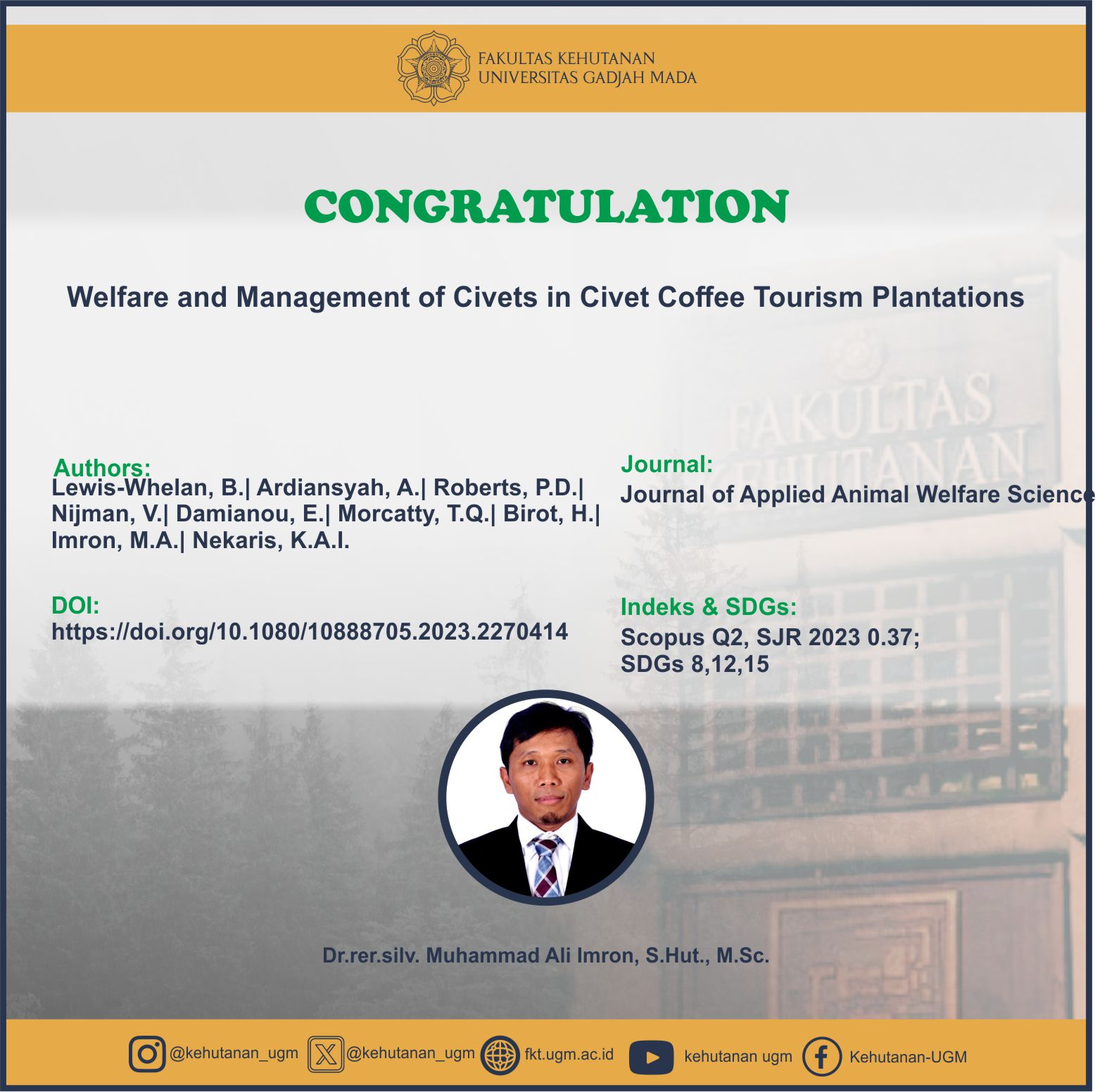
  • Publication: Welfare and Management of Civets in Civet Coffee Tourism Plantations

Publication: Welfare and Management of Civets in Civet Coffee Tourism Plantations

  • berita penelitian dan publikasi
  • 29 April 2024, 01.47
  • Oleh: Bag. Riset & Literasi
  • 0

Abstract
Civet coffee is produced with coffee beans that have passed through the digestive tract of civets which are then processed for drinking. Outlets, known as civet coffee tourism plantations are popular tourist attractions in Bali, Indonesia. These outlets keep caged civets for public viewing and sell civet coffee. We assessed civet welfare in 29 civet coffee tourism plantations to assess husbandry factors, the five freedoms and body condition scores. We also assessed civet welfare in eight wildlife markets where civets are sourced for civet coffee tourism and calculated turnover of civets. We found 99 civets in civet coffee tourism plantations and 136 in markets, where. Annually between 400 and 800 civets are sold. Welfare standards do not meet the Indonesian laws and regulations. Diet, hygiene, presence of water and mobility affected body condition scores and no civet met all of the five freedoms. Enforcement of welfare and trade laws is needed to improve civet welfare, and to curb the illegal civet trade. Tourists frequenting civet coffee tourism plantations should be made aware of the low welfare standards to inform their choice about supporting this industry.

SDGs:
SDG 8: Decent Work and Economic Growth
SDG 12: Responsible Consumption and Production
SDG 15: Life on Land

Link Dokumen:
Download

Leave A Comment Cancel reply

Your email address will not be published. Required fields are marked *

*

Universitas Gadjah Mada

FAKULTAS KEHUTANAN
Universitas Gadjah Mada
Jl. Agro No. 1 Bulaksumur Yogyakarta 55281
Telp. (0274) 512102, 6491420 Fax. (0274) 550541
Email: fkt@ugm.ac.id

UNIVERSITY ADMISSION

  • SNMPTN
  • SBMPTN
  • PBUTM
  • UTUL

DEPARTMENT

  • Forest Management
  • Forest Product Technology
  • Silviculture
  • Forest Resource Conservation

Informasi Publik

  • Permohonan Informasi Publik
  • Daftar Informasi Tersedia Secara Berkala
  • Daftar Informasi Tersedia Setiap Saat

© FKT - Universitas Gadjah Mada

KEBIJAKAN PRIVASI/PRIVACY POLICY

[EN] We use cookies to help our viewer get the best experience on our website. -- [ID] Kami menggunakan cookie untuk membantu pengunjung kami mendapatkan pengalaman terbaik di situs web kami.I Agree / Saya Setuju