• UGM
  • Academic Portal
  • IT Center
  • Library
  • Research
  • Webmail
  • Informasi Publik
Universitas Gadjah Mada Fakultas Kehutanan
Universitas Gadjah Mada
  • Tentang Kami
    • Sambutan Dekan
    • Selayang Pandang
    • VISI MISI
    • Sejarah Fakultas
    • Pimpinan Fakultas
    • Pimpinan Departemen
    • Pimpinan Program Studi
    • Pimpinan Laboratorium
    • DOSEN
    • STAFF TENDIK
    • Laporan TAHUNAN Dekan
    • ALUMNI
  • Akademik
    • PROGRAM SARJANA
    • PROGRAM MAGISTER
    • PROGRAM DOKTOR
    • PROGRAM PROFESI
    • AKREDITASI PROGRAM STUDI
    • Double Degree
    • KALENDER AKADEMIK
  • KEMAHASISWAAN
    • KEMAHASISWAAN
    • LEM-DPM
      • Lembaga Eksekutif Mahasiswa
      • Dewan Perwakilan Mahasiswa
    • BSO
      • Mapala Silvagama
      • KSK
      • IFSA LC UGM
      • FSC
      • KMIK
      • KMKK BONITA
    • HMM
      • FORESTECH
      • HIMABA
      • FORESTATION
      • KMMH
    • PIONIR UGM
  • RISET & INOVASI
    • Publikasi Riset Dosen & Mahasiswa
    • HKI/PATEN/HAK CIPTA
    • Jurnal Ilmu Kehutanan
    • KERJASAMA
    • PUSAT KAJIAN
      • “SEBIJAK” INSTITUTE
      • SJB
      • PUSAT KAJIAN KEHUTANAN SOSIAL
    • KHDTK WANAGAMA
  • ADMISI
    • SARJANA KEHUTANAN
    • PROFESI INSINYUR KEHUTANAN
    • MAGISTER ILMU KEHUTANAN
    • DOKTOR ILMU KEHUTANAN
  • PENJAMINAN MUTU
  • Beranda
  • berita penelitian dan publikasi
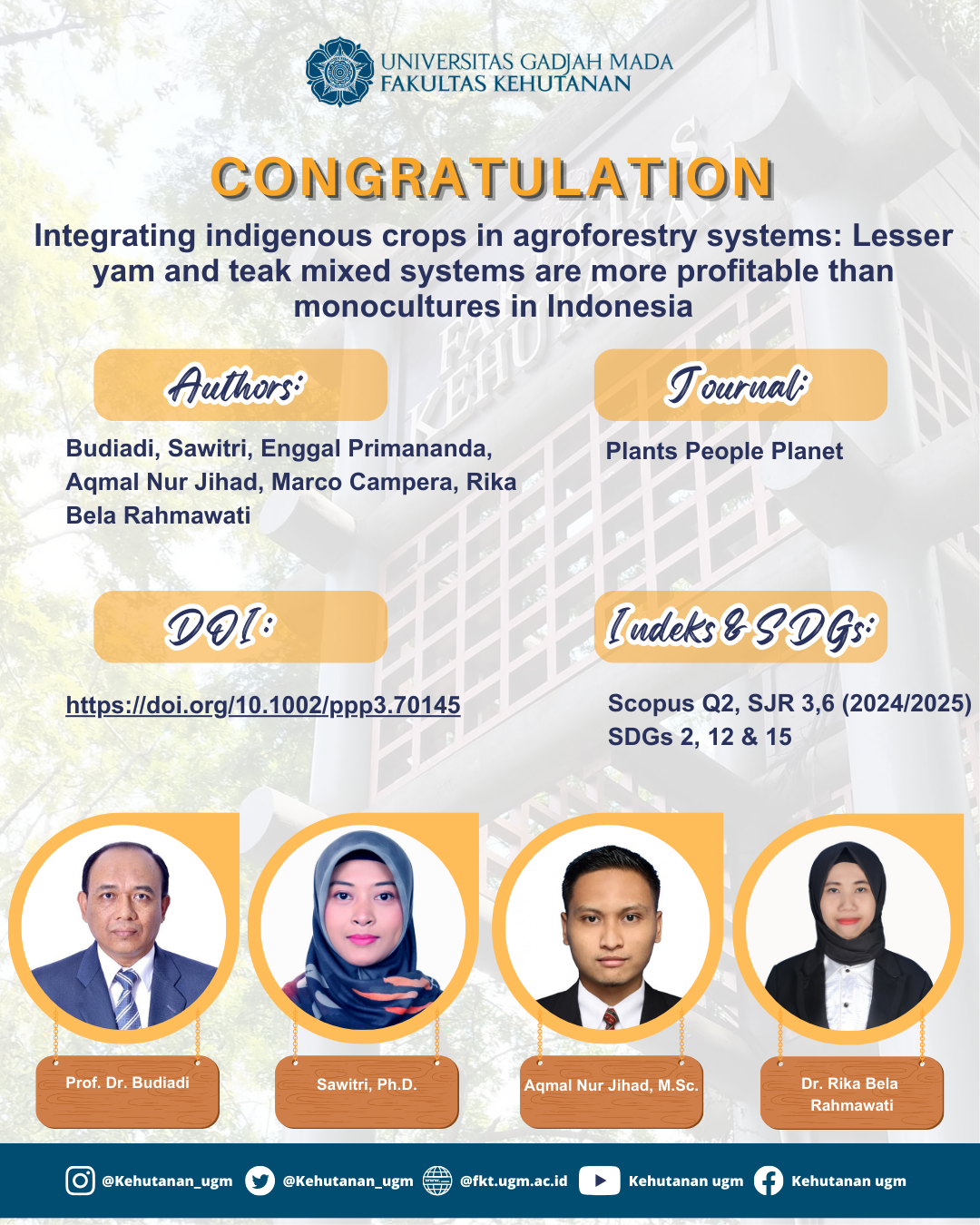
  • Integrating indigenous crops in agroforestry systems: Lesser yam and teak mixed systems are more profitable than monocultures in Indonesia

Integrating indigenous crops in agroforestry systems: Lesser yam and teak mixed systems are more profitable than monocultures in Indonesia

  • berita penelitian dan publikasi
  • 8 January 2026, 04.55
  • Oleh: Bag. Riset & Literasi
  • 0

Abstract
Societal impact statement
Major staple crops are often introduced and cultivated in monocultures. Yams arestaple crops native to the majority of low- and middle-income countries and can pro-vide an alternative to introduced staple crops. [Correction added on 9 January 2026,after first online publication: In the preceding sentence, stable has been corrected tostaple in this version.] We showed that lesser yams cultivated together with teaktrees (planted at the border of the farm) are more profitable than lesser yam mono-culture. This supports the idea that indigenous crops, which are known to be moreresilient to local conditions, are suitable to be integrated in agroforestry systems(with the benefit of having further profits from other crops and/or trees).

Summary
• Lesser yam, Dioscorea esculenta (Lour.) Burkill, is a staple crop massively cultivatedin monoculture (yam monoculture: YM) and more rarely cultivated in agroforestrysystems, where the shading effect of the trees it thought to reduce crop yield. Thisstudy aims to compare agroforestry and monoculture lesser yam systems in termsof tuber productivity, standing stock volume, harvest index (HI), efficiency of stor-age root production (ESRP), and financial analysis.
• We compared plots in YM with two agroforestry systems, trees along border(TAB) and teak–yam intercropping (TYI), in a yam production village in CentralJava. Profitability analysis was done to predict the economic value of the planta-tions and to determine the most beneficial farming system to farmers.
• The YM produced the highest tuber biomass of yam, but the TAB produced thehighest tuber yield (F = 38.977, P < 0.001). YM had the lowest Benefit–Cost Ratio(1.60), compared to TAB (2.01), TYI (1.84), and teak monoculture (TM, 1.90). TMwas less profitable than TYI and TAB based on Net Present Value and EquivalentAnnual Income.
• We found that lesser yam is suitable to grow under the canopy cover, and teaktrees serve as living stakes for yam vines. Furthermore, upon financial analysis,

SDGs:
SDG 2:Zero Hunger
SDG 12:Responsible Consumtion and Production
SDG 15:Life on Land

Link Dokumen:
Download

Leave A Comment Cancel reply

Your email address will not be published. Required fields are marked *

*

Universitas Gadjah Mada

FAKULTAS KEHUTANAN
Universitas Gadjah Mada
Jl. Agro No. 1 Bulaksumur Yogyakarta 55281
Telp. (0274) 512102, 6491420 Fax. (0274) 550541
Email: fkt@ugm.ac.id

UNIVERSITY ADMISSION

  • SNMPTN
  • SBMPTN
  • PBUTM
  • UTUL

DEPARTMENT

  • Forest Management
  • Forest Product Technology
  • Silviculture
  • Forest Resource Conservation

Informasi Publik

  • Permohonan Informasi Publik
  • Daftar Informasi Tersedia Secara Berkala
  • Daftar Informasi Tersedia Setiap Saat

© FKT - Universitas Gadjah Mada

KEBIJAKAN PRIVASI/PRIVACY POLICY

[EN] We use cookies to help our viewer get the best experience on our website. -- [ID] Kami menggunakan cookie untuk membantu pengunjung kami mendapatkan pengalaman terbaik di situs web kami.I Agree / Saya Setuju