• UGM
  • Academic Portal
  • IT Center
  • Library
  • Research
  • Webmail
  • Informasi Publik
Universitas Gadjah Mada Fakultas Kehutanan
Universitas Gadjah Mada
  • Tentang Kami
    • Sambutan Dekan
    • Selayang Pandang
    • VISI MISI
    • Sejarah Fakultas
    • Pimpinan Fakultas
    • Pimpinan Departemen
    • Pimpinan Program Studi
    • Pimpinan Laboratorium
    • DOSEN
    • STAFF TENDIK
    • Laporan TAHUNAN Dekan
    • ALUMNI
  • Akademik
    • PROGRAM SARJANA
    • PROGRAM MAGISTER
    • PROGRAM DOKTOR
    • PROGRAM PROFESI
    • AKREDITASI PROGRAM STUDI
    • Double Degree
    • KALENDER AKADEMIK
  • KEMAHASISWAAN
    • KEMAHASISWAAN
    • LEM-DPM
      • Lembaga Eksekutif Mahasiswa
      • Dewan Perwakilan Mahasiswa
    • BSO
      • Mapala Silvagama
      • KSK
      • IFSA LC UGM
      • FSC
      • KMIK
      • KMKK BONITA
    • HMM
      • FORESTECH
      • HIMABA
      • FORESTATION
      • KMMH
    • PIONIR UGM
  • RISET & INOVASI
    • Publikasi Riset Dosen & Mahasiswa
    • HKI/PATEN/HAK CIPTA
    • Jurnal Ilmu Kehutanan
    • KERJASAMA
    • PUSAT KAJIAN
      • “SEBIJAK” INSTITUTE
      • SJB
      • PUSAT KAJIAN KEHUTANAN SOSIAL
    • KHDTK WANAGAMA
  • ADMISI
    • SARJANA KEHUTANAN
    • PROFESI INSINYUR KEHUTANAN
    • MAGISTER ILMU KEHUTANAN
    • DOKTOR ILMU KEHUTANAN
  • PENJAMINAN MUTU
  • Beranda
  • berita penelitian dan publikasi
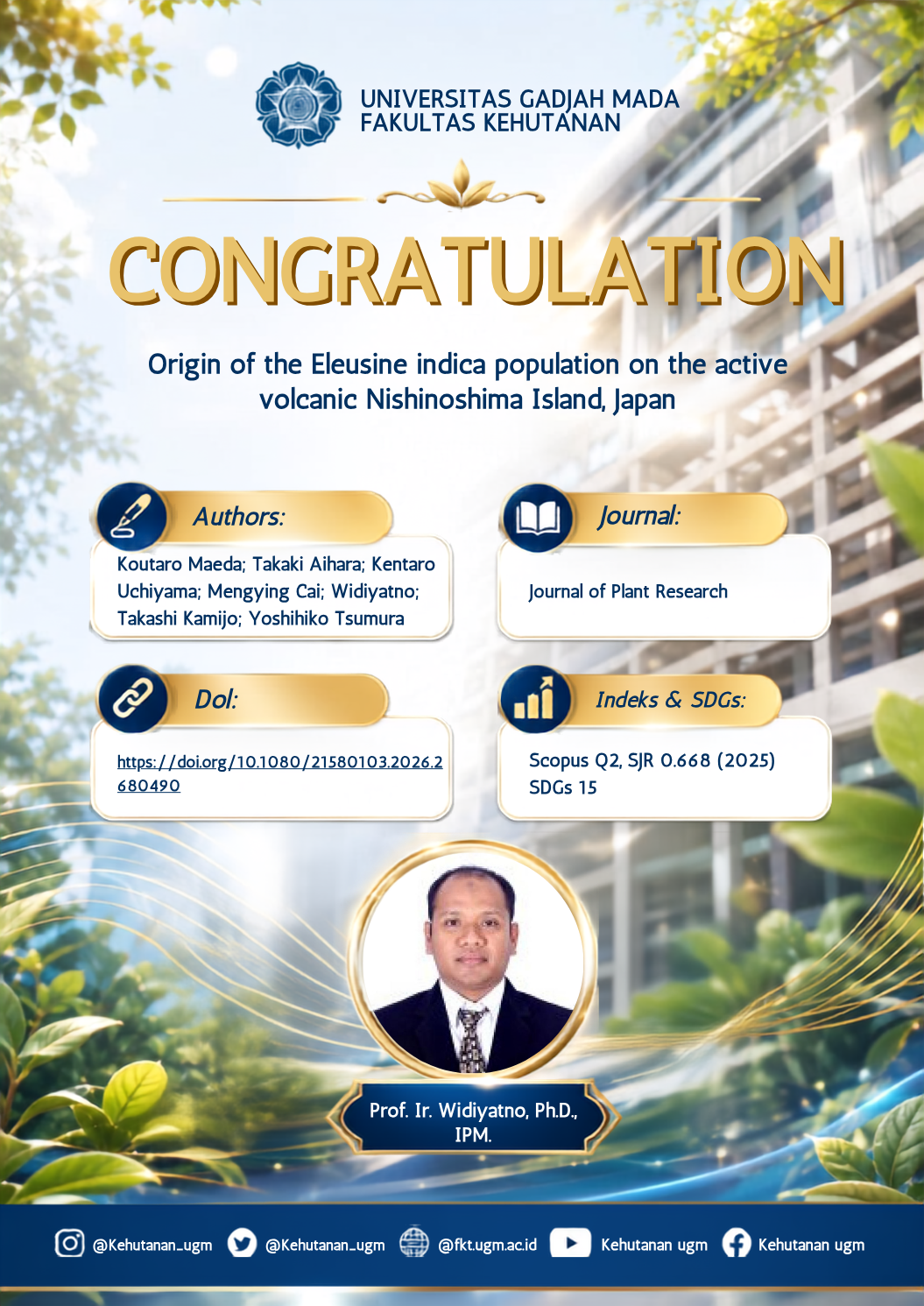
  • Origin of the Eleusine indica population on the active volcanic Nishinoshima Island, Japan

Origin of the Eleusine indica population on the active volcanic Nishinoshima Island, Japan

  • berita penelitian dan publikasi
  • 7 August 2026, 04.49
  • Oleh: Bag. Riset & Literasi
  • 0

Abstract
Nishinoshima Island, located approximately 1,000 km south of mainland Japan and 130 km from the Ogasawara Islands, emerged as a new island due to volcanic activity in 1973. On this isolated island, grasses such as Eleusine indica and Portulaca oleracea have been observed growing, though their routes of invasion remain unknown. Numerous seabirds have been spotted inhabiting and breeding around Nishinoshima Island, potentially contributing to the spread of these plants without any possibility of anthropogenic influence. The aim of this study was to trace the origin of the E. indica population on Nishinoshima Island using genetic methods. We collected samples of E. indica from Nishinoshima Island, mainland Japan, the Ryukyu Islands, the Ogasawara Islands, and other locations. In this study, we utilized two types of DNA with different inheritance modes: chloroplast DNA (cpDNA) and nuclear DNA. For cpDNA, five polymorphic regions were analyzed, while genetic diversity and structure were also assessed for nuclear DNA using MIG-seq (Multiplexed inter-simple sequence repeat (ISSR) genotyping by sequencing), a method for detecting nucleotide polymorphisms with next-generation sequencing technology. Genetic diversity analysis revealed high genetic diversity in the mainland Japan population. Additionally, cpDNA analysis confirmed the presence of the Nishinoshima haplotype on several islands, including Ogasawara Island. Nuclear DNA analysis showed a close relationship between the Nishinoshima population and those on Ogasawara, Hachijojima, Okinawa and Indonesia. Given instances of seabirds carrying tiny seeds over long distances, it is plausible that E. indica seeds were transported from distant locations by migrating birds. Based on the genetic diversity of E. indica on Nishinoshima, it was considered that this population originated from a single or a few seed as a result of an extremely rare seed dispersal event.

SDGs:
SDG 15:Life on Land

Link Dokumen:
Download

Leave A Comment Cancel reply

Your email address will not be published. Required fields are marked *

*

Universitas Gadjah Mada

FAKULTAS KEHUTANAN
Universitas Gadjah Mada
Jl. Agro No. 1 Bulaksumur Yogyakarta 55281
Telp. (0274) 512102, 6491420 Fax. (0274) 550541
Email: fkt@ugm.ac.id

UNIVERSITY ADMISSION

  • SNMPTN
  • SBMPTN
  • PBUTM
  • UTUL

DEPARTMENT

  • Forest Management
  • Forest Product Technology
  • Silviculture
  • Forest Resource Conservation

Informasi Publik

  • Permohonan Informasi Publik
  • Daftar Informasi Tersedia Secara Berkala
  • Daftar Informasi Tersedia Setiap Saat

© FKT - Universitas Gadjah Mada

KEBIJAKAN PRIVASI/PRIVACY POLICY

[EN] We use cookies to help our viewer get the best experience on our website. -- [ID] Kami menggunakan cookie untuk membantu pengunjung kami mendapatkan pengalaman terbaik di situs web kami.I Agree / Saya Setuju