• UGM
  • Academic Portal
  • IT Center
  • Library
  • Research
  • Webmail
  • Informasi Publik
  • Languages
Universitas Gadjah Mada Fakultas Kehutanan
Universitas Gadjah Mada
  • Tentang Kami
    • Visi dan MIsi
    • Kelembagaan Fakultas
    • Sejarah dan Perkembangan
    • Staff Pendidik
  • Akademik
    • Sistem Pendidikan
    • Departemen
    • Sistem Kredit Semester
    • BUKU PANDUAN AKADEMIK
  • KEMAHASISWAAN
    • KEMAHASISWAAN
    • LEM
    • PPSMB Pelestari
  • Penelitian dan Publikasi
    • Berita Penelitian dan Publikasi
    • Penelitian
    • Publikasi
    • Kekayaan Intelektual
    • Jangka Benah
  • Pengabdian Masyarakat
    • Pengabdian Dosen
    • Kerja Sama
    • WANAGAMA
    • KHDTK NGANDONG-GETAS
  • Beranda
  • berita penelitian dan publikasi
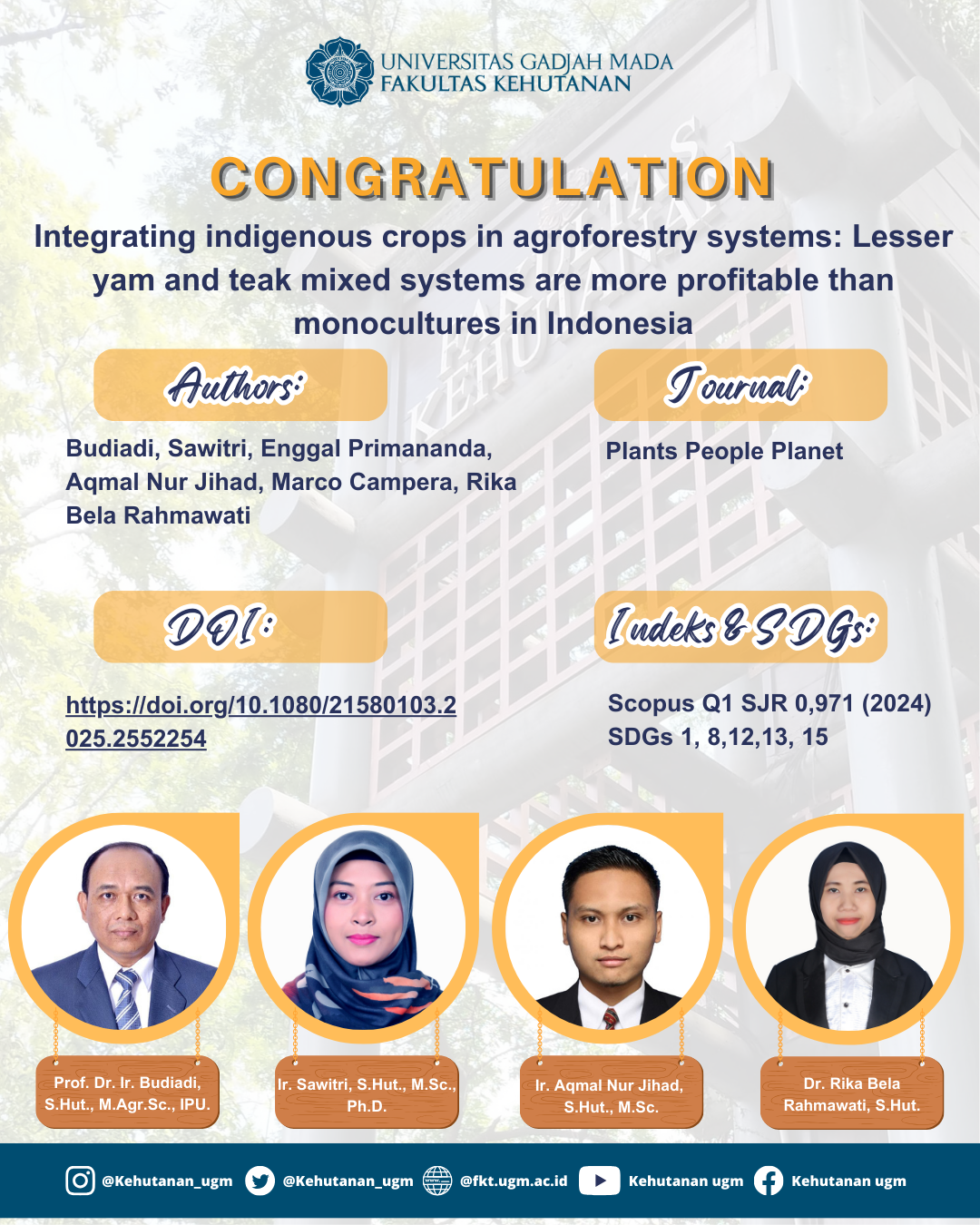
  • Integrating indigenous crops in agroforestry systems: Lesseryam and teak mixed systems are more profitable thanmonocultures in Indonesia

Integrating indigenous crops in agroforestry systems: Lesseryam and teak mixed systems are more profitable thanmonocultures in Indonesia

  • berita penelitian dan publikasi
  • 8 January 2026, 16.52
  • Oleh: Bag. Riset & Literasi
  • 0

Abstract
Societal impact statement
Major staple crops are often introduced and cultivated in monocultures. Yams are staple crops native to the majority of low- and middle-income countries and can provide an alternative to introduced staple crops. [Correction added on 9 January 2026, after first online publication: In the preceding sentence, stable has been corrected to staple in this version.] We showed that lesser yams cultivated together with teak trees (planted at the border of the farm) are more profitable than lesser yam monoculture. This supports the idea that indigenous crops, which are known to be more resilient to local conditions, are suitable to be integrated in agroforestry systems (with the benefit of having further profits from other crops and/or trees).

SDGs:
SDG 1 :No Poverty
SDG 8 :Decent Works and Economic Growth
SDG 12:Responsible Consumtion and Production
SDG 13:Climate Action
SDG 15:Life on Land

Link Dokumen:
Download

Leave A Comment Cancel reply

Your email address will not be published. Required fields are marked *

*

Universitas Gadjah Mada

FAKULTAS KEHUTANAN
Universitas Gadjah Mada
Jl. Agro No. 1 Bulaksumur Yogyakarta 55281
Telp. (0274) 512102, 6491420 Fax. (0274) 550541
Email: fkt@ugm.ac.id

UNIVERSITY ADMISSION

  • SNMPTN
  • SBMPTN
  • PBUTM
  • UTUL

DEPARTMENT

  • Forest Management
  • Forest Product Technology
  • Silviculture
  • Forest Resource Conservation

Informasi Publik

  • Permohonan Informasi Publik
  • Daftar Informasi Tersedia Secara Berkala
  • Daftar Informasi Tersedia Setiap Saat

© FKT - Universitas Gadjah Mada

KEBIJAKAN PRIVASI/PRIVACY POLICY

[EN] We use cookies to help our viewer get the best experience on our website. -- [ID] Kami menggunakan cookie untuk membantu pengunjung kami mendapatkan pengalaman terbaik di situs web kami.I Agree / Saya Setuju